The Day Has Come, — Our new paper “Evolution of structural characteristics and contact force of ceramic breeder beds under uniaxial compression test of nuclear fusion blanket” is now officially published.
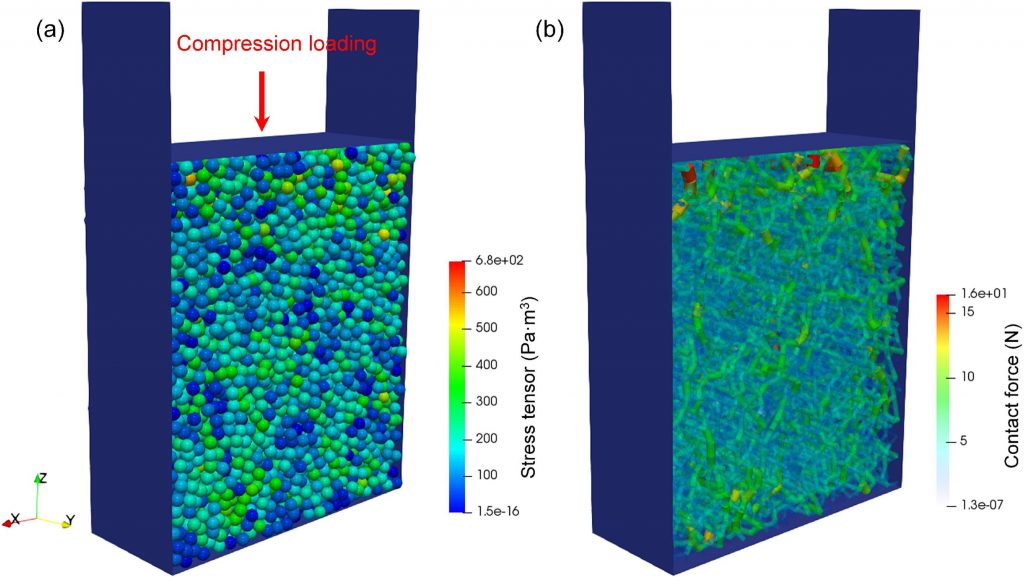
If nuclear fusion is humanity’s pursuit of the “holy grail of energy,” then the ceramic breeder bed inside a fusion reactor is the very “soil” that nurtures the energy of the future. Our work seeks to answer a critical question: Will this “soil” remain robust and reliable under extreme conditions?
Imagine, inside a future fusion reactor, the ceramic pebble bed quietly fulfills multiple roles: producing tritium, transferring heat, and withstanding mechanical pressure. Like billions of tiny “energy seeds,” these pebbles must maintain structural integrity and functional stability under harsh environments—high temperature, radiation, and mechanical load. Through uniaxial compression tests, we closely observed how these ceramic particles evolve under pressure—how their structures transform, how contact forces distribute. These subtle “breaths” and “adjustments” are, in fact, vital to the long-term safety and performance of the reactor core.
Now, all that work is crystallized into the concise title on the screen. This is not just the publication of a paper, but another firm step forward on the long path toward “igniting the light of fusion.”
This article investigates the structural characteristics and contact forces of ceramic breeder beds under compression in nuclear fusion blankets . Using Discrete Element Method (DEM) simulations, researchers analyzed uniaxial compression tests on tritium breeder pebble beds .
If you are also interested in future energy, materials science, or the engineering challenges behind fusion, you are welcome to read our paper and join the discussion.
Key Findings
- Plastic Deformation: Cyclic compression causes irreversible plastic deformation that increases with higher compressive loads, primarily due to pebble bed densification
- Structural Changes: Average packing factor increases from 0.6015 to 0.6020 as maximum load rises from 4 MPa to 8 MPa
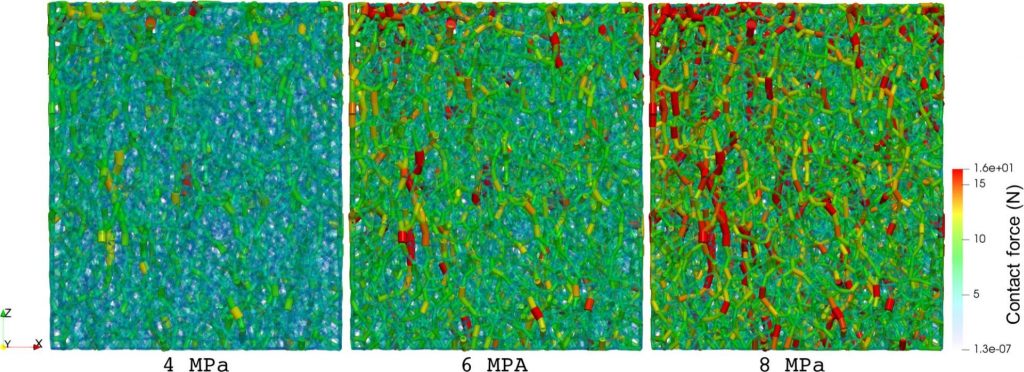
- Contact Forces: Both average and maximum contact forces increase linearly with compressive load, following the relationship $f_{avg} = 0.2924 + 0.6028x$ and $f_{max} = 0.0981 + 4.1713x$
- Force Chain Evolution: Strong contact force chains develop and align with the compression direction, showing pronounced anisotropy
These findings provide valuable insights for evaluating tritium breeder performance and assessing fusion reactor blanket service life .
Abstract
The primary role of tritium breeders in fusion reactor blankets is to produce tritium, which accumulates in fixed pebble beds within the blankets. The service performance of these pebble beds depends on pebble packing behavior and pebble mechanics. In this work, the Discrete Element Method simulations were utilized to model uniaxial confined compression tests on tritium breeder pebble beds and analyze the evolution of pebble packing structure characteristics and inter-pebbles contact forces. The results indicate that plastic deformation occurs within the pebble bed during cyclic compression. Plastic deformation progressively increases as the maximum compressive load rises. This primarily stems from densification of the pebble packing structure induced by compression process. Furthermore, the external compression process generates numerous interparticle strong contact force chains within the pebble bed. As the maximum compressive load increases, the orientation distribution of normal contact forces progressively aligns with the compression loading direction, exhibiting pronounced anisotropy. These findings provide a valuable reference for evaluating tritium breeder pebble beds and assessing the service life of fusion reactor blanket systems.
[1] Baoping Gong, Yongjin Feng, Long Zhang, Hao Cheng, Zhihao Hong, Juemin Yan, Long Wang, Qixiang Cao, Jiming Chen. Evolution of structural characteristics and contact force of ceramic breeder beds under uniaxial compression test of nuclear fusion blanket, Nuclear Materials and Energy, 2026, 47:102125 [PDF, DOI, Link]